Conference 2026: ADR Mechanisms for Disputes Arising from Contingent Incidents Affecting Obligations: A Shari’ah and Legal Perspective
29/10/2026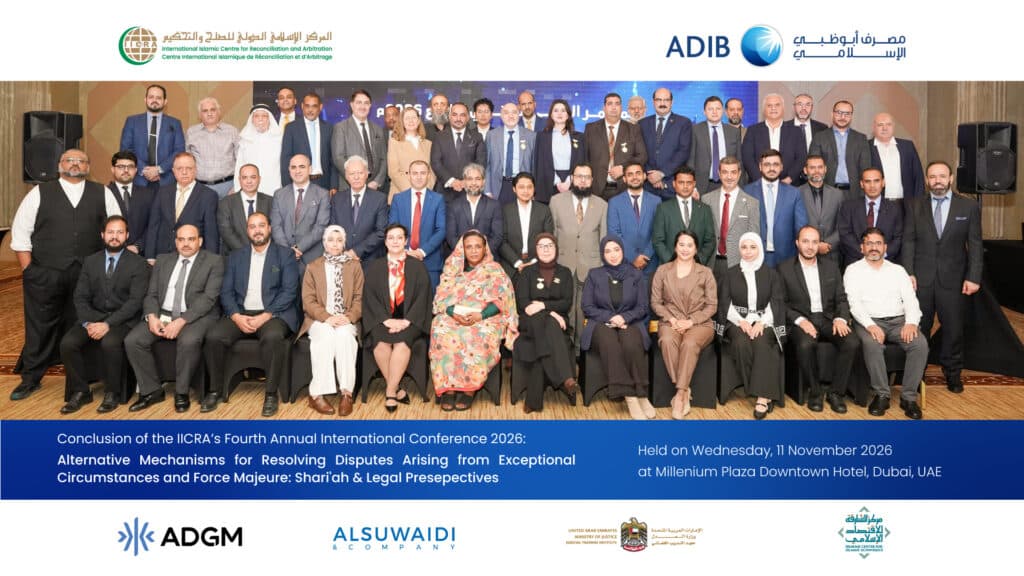
IICRA’s Fourth Annual International Conference 2026 Explores Alternative Mechanisms for Resolving Disputes Arising from Exceptional Circumstances and Force Majeure
Bringing Together Leading Legal and Shari’ah Experts, Arbitrators, and Industry Professionals, with Abu Dhabi Islamic Bank as Gold Sponsor and Abu Dhabi Global Market as Strategic Partner
Dubai, 11 November 2026
The International Islamic Centre for Reconciliation and Arbitration (IICRA) held its Fourth Annual International Conference on Wednesday, 1 Jumada al-Akhirah 1448 AH, corresponding to 11 November 2026, in Dubai, under the theme “Alternative Mechanisms for the Settlement of Disputes Arising from Exceptional Circumstances Affecting Obligations: A Shari’ah and Legal Perspective.” The conference was held as part of Dubai Arbitration Week 2026, with Abu Dhabi Islamic Bank (ADIB) as Gold Sponsor and Abu Dhabi Global Market (ADGM) as Strategic Partner, in cooperation with Al Suwaidi & Company, the Judicial Training Institute at the Ministry of Justice, and the Sharjah Centre for Islamic Economics.
The conference was organised as part of IICRA’s efforts to strengthen alternative dispute resolution mechanisms and develop Shari’ah and legal approaches to addressing the effects of exceptional circumstances and force majeure on contractual relationships, thereby promoting justice, protecting rights, and maintaining stability in economic and commercial transactions.
The shed light on the Shari’ah and legal principles governing exceptional circumstances and force majeure and their implications for contractual obligations. Particular emphasis was placed on the role of reconciliation, arbitration, and mediation in resolving related disputes, alongside an examination of IICRA’s reconciliation and arbitration rules, the mediation framework of ADGM Courts, the Dispute Adjudication Board (DAB) Rules, and their practical application within the Islamic Building and Construction Contract (IBCC).
IICRA Reinforces Its Role in Advancing Alternative Dispute Resolution Mechanisms
During the opening ceremony, H.E. Professor Jassim Ali Salem Al Shamsi, Chairman of IICRA’s Board of Trustees, delivered an address highlighting the Centre’s role in supporting the Islamic financial industry and strengthening institutional reconciliation and arbitration. He also underscored the importance of continuously developing alternative dispute resolution mechanisms in accordance with the principles of Islamic Shari’ah and contemporary legal practices.
The opening ceremony also featured an address by Ms. Linda Fitz-Alan, Registrar and Chief Executive of ADGM Courts, followed by remarks from a representative of Abu Dhabi Islamic Bank, the conference’s Gold Sponsor, reflecting the importance of cooperation among legal, judicial, and financial institutions in promoting effective dispute resolution practices.
Dr. Rami Sulaiman Abudagga, Secretary-General of IICRA, formally inaugurated the conference, which addressed the importance of developing practical Shari’ah-compliant and legal solutions to contractual disputes arising from exceptional circumstances and force majeure, particularly in light of economic and commercial challenges that may affect contractual performance and the balance of contractual relationships.
These efforts are particularly significant in strengthening confidence among contracting parties, preventing the escalation of disputes, and encouraging greater reliance on reconciliation, arbitration, and mediation as effective means of resolving disagreements, thereby promoting transactional stability, justice, and the protection of legitimate interests.
Strengthening Institutional Cooperation and Strategic Partnerships
The conference programme also included the signing of cooperation agreements, reflecting IICRA’s commitment to strengthening ties with specialised institutions and organisations, expanding cooperation in legal, Shari’ah and arbitration matters, exchanging expertise, and developing professional services related to dispute resolution.
Expert Sessions Examine Shari’ah, Legal, and Practical Aspects of Dispute Resolution
The conference featured two specialised sessions addressing key Shari’ah, legal, and practical challenges associated with disputes arising from exceptional circumstances and force majeure, bringing together distinguished experts, arbitrators, and legal professionals.
Key Recommendations of IICRA’s Fourth Annual International Conference 2026
Following the conference sessions and presentations, a series of proposed recommendations was developed in line with the themes discussed, aimed at strengthening alternative dispute resolution mechanisms and advancing Shari’ah and legal frameworks for addressing the consequences of exceptional circumstances and force majeure.
The proposed recommendations are as follows:
1. Promoting Alternative Dispute Resolution Mechanisms: Encourage greater use of reconciliation, mediation, and institutional arbitration in resolving contractual disputes arising from exceptional circumstances and force majeure, with a view to achieving justice, ensuring timely dispute resolution, and reducing litigation costs.
2. Developing Shari’ah and Legal Frameworks: Support specialised studies and research aimed at developing appropriate frameworks for addressing exceptional circumstances and force majeure, ensuring a fair balance of contractual obligations and protecting the legitimate rights and interests of all parties, while observing the principles of Islamic Shari’ah and applicable laws.
3. Encouraging the Use of IICRA’s Institutional Reconciliation and Arbitration Rules: Promote awareness and wider adoption of IICRA’s institutional dispute resolution services, highlighting their advantages and effectiveness in resolving commercial and financial disputes in accordance with the principles of Islamic Shari’ah.
4. Promoting the Application of Dispute Adjudication Board (DAB) Rules: Encourage the adoption of DAB mechanisms, particularly in construction contracts and infrastructure projects, as effective tools for addressing disagreements during project execution and preventing disputes from escalating.
5. Further Developing the Islamic Building and Construction Contract (IBCC): Continue improving the IBCC by incorporating feedback from experts, practitioners, and practical applications, particularly regarding exceptional circumstances, force majeure, and dispute resolution provisions, thereby promoting fairness and balance in contractual relationships.
6. Expanding Specialised Training and Professional Development: Strengthen cooperation with judicial, legal, and academic institutions to organise specialised training programmes that enhance the capabilities of arbitrators, mediators, experts, and practitioners in resolving disputes related to exceptional circumstances and force majeure.
7. Strengthening Local and International Institutional Cooperation: Expand strategic partnerships and professional cooperation to facilitate knowledge exchange, improve Shari’ah and legal dispute resolution practices, and support initiatives aimed at achieving legal certainty and contractual stability.
8. Monitoring the Implementation of Conference Recommendations: Establish appropriate follow-up mechanisms in coordination with relevant institutions, organise specialised seminars and workshops, and encourage research and professional initiatives aimed at translating the recommendations into practical measures that benefit various economic sectors.
9. The Secretary-General of IICRA, Dr. Rami Sulaiman, emphasised that advancing the Islamic finance industry requires the application of Shari’ah principles at every stage of a transaction, beginning with the drafting of contracts in accordance with Islamic Shari’ah, followed by their proper implementation in practice, and ultimately the resolution of any disputes through Islamic arbitration, in accordance with the words of Allah Almighty in the Holy Qur’an: But no, by your Lord, they will not truly believe until they make you judge concerning that over which they dispute among themselves and then find within themselves no discomfort from what you have judged and submit in full submission.” [Surah An-Nisa, Verse 65]. This noble verse provided a fitting conclusion to the proceedings of the Conference.